
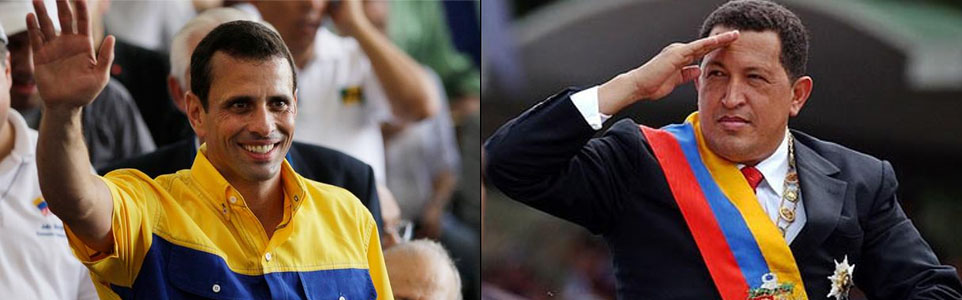
Tensions in Venezuela have been relatively high in recent weeks nearing the crucial election that will see opposition party leader, Henrique Capriles challenge the populist, Hugo Chavez for presidency on October 7th. On Saturday, two local leaders of the Capriles camp were shot dead during a rally in the state of Barinas and there have been many rumours that pro-Chavez militia plan to stage violent protests in the case of an opposition win. This appears a realistic possibility, as militia burnt several trucks belonging to the Capriles camp just last week. Promises have been made by both parties and this has been followed by fluctuating leads in the polls, the most recent showing Chavez with a ten-point lead.
This rivalry has only been intensified by recent comments made by opposition challenger, Henrique Capriles, in relation to the country’s foreign policy. Should he come into power, Capriles has vowed to halt arms purchases from Russia; review crucial oil deals and diminish relations with Iran.
The oil-rich Latin American country has spent more than fourteen billion dollars on arms purchases from Russia in recent years and has thus developed a comfortable military relationship the nation. This is the relationship Capriles wishes to see laid to rest, as he remarked ”I am not going to buy more weapons. I think the policy [towards Russia] has been mistaken.”
Capriles also wishes to see a shift away from one of the fastest growing nations in the world, which is also beneficiary to 640,000 barrels of Venezuelan oil a day. China’s investment in the Andean nation’s oil sector is substantial. The Chinese government’s 2012 budget included more than $4 billion for state-owned China National Petroleum Corporation to enter joint ventures in Venezuela’s oil-rich Orinoco Belt. Chavez himself said he expects sales to China to reach 1 million bpd in the medium term. This is all under threat as Capriles states in his recent interview that, ”We have to revise every deal” and that the agreements are not “functioning”.
Until 1999, almost all of Venezuela’s oil exports went directly to the US. However, as Chavez took power, sales of crude became more diverse funnelling through to China, India, Japan and other nations. Capriles is much more likely to bow down to US interests, rendering Venezuela economically submissive once again. He plans to loosen relations with China and Russia as well as Nicaragua, Cuba and Iran and as a result implicate trading with said nations.
Affable trading relations with China has meant that Venezuela has ceased to become subject to the problems of the US and European economy, nor to the devaluation of the dollar. As well as Chinese investment, this is not an advantage Venezuela can afford to loose, as is the relationship with globally powerful Russia.
Homicide rates and inflation remain considerably high in Venezuela, and certainly progression must be made, however an adjacent relationship with the USA, as opposed to with China, Russia, Iran and Cuba is seemingly reminiscent of the submissiveness of the 1960′s, in relation to Latin American nations. Venezuela’s foreign policy can be reformed to include a wider circle of nations, however a complete overhaul by Capriles will prove almost disastrous in the long-term.