
In 1995, and during Quebec’s major struggle to separate from the rest of Canada, the results of the referendum were extremely close, but the non-separatists won nonetheless. Canada breathed a sigh of relief, but the infuriated Jacques Parizeau, Quebec’s premier then, in his conceding speech, said that the reasons why the votes tilted towards the non-separatists were “money and ethnic vote.” This phrase resonated poorly with the “ethnic voters” and Canada at large.
In addition to immediately costing him his position and political career, Parizeau’s notorious phrase is quite telling. The ethnic vote, in other words, the minorities in Quebec, were the reason behind Quebec’s not separating.
The results of the US 2012 elections are in. President Obama won another four years in office. Of course, many reasons came to play, but Mitt Romney seemed to have put his foot in his mouth when he opposed any form of amnesty for illegal immigrants, but instead he encouraged illegal aliens to return home voluntarily, “a policy of self-deportation.” Minorities, in particular Hispanics from across the Mexican border, felt targeted and ostracized, and it disappointed the Latino voter in Romney.
Not surprisingly, Hispanics played a significant role in the 2012 US Election. Hispanics are the largest minority base in the US after African Americans. They form 16 percent, 50 million Latinos, of the 308 US population. Pause and ponder: did they matter? Were they an asset? How should President Obama and Governor Romney have taken advantage of this immense source of votes?
Mitt Romney didn’t use this asset wisely, and his words may have increased President Obama’s chances to secure another term in the White House. It is important, when fighting such a campaign, to gain and make use of every available vote.
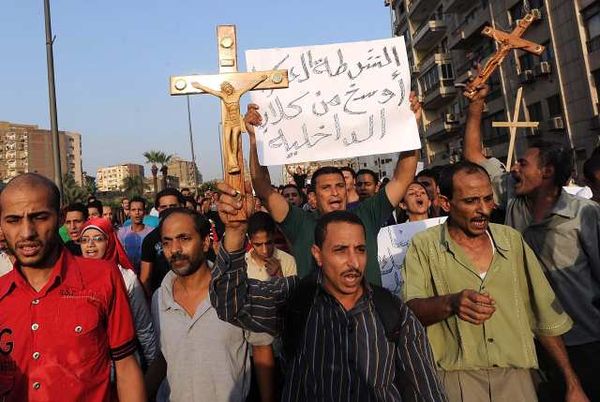
Now, let us see how presidential and parliamentary elections were run in Egypt. What a stark incomparable difference! The concept of exclusion, versus inclusion, was the prominent one. From the start Egyptians were so polarized that it became a life-threatening struggle. In some instances it seemed to say, “I will win or you will die” instead of saying, “I will win because I can get your vote, too.”
Intentionally the Freedom and Justice Party, and more so the Al Nour Party marginalized Egyptian Christians, be Copts or other Christians. Both parties ran on platforms that ignored minorities.
In Egypt, the goal was to win by playing down the value of minorities, by not giving them much thought or presence, and by assuming they are not there. The battle, and indeed it was a battle, demoted and marginalized minorities. “Our” followers, “our” team, and “our” party are by far more superior and capable than anyone else out there. You were either one of us or you were nobody: this seemed to be the way the campaigns were conducted.
Now, come to think of it, Egyptians Christians should be a group to be reckoned with. Ten percent of the total population of Egypt is not loose change. If one candidate can add an average of 10 million to his voters, he would win by a huge margin. Not that all 10 million would vote, but it is a notion that is worth considering.
Not only in Egyptian political elections but also in social choices made regularly, the shrewd candidate or competitor should go after the votes of minorities. If two Muslims run for an elected post such as the president of a union, for example, if one candidate can sway the Copts to choose him, he will win over the other runner.
And since it is indeed very easy to alienate voters or comprise them, it is up to the candidates to choose the path of exclusion or inclusion.
I also must encourage Copts to realize their potential in any campaign. Copts must understand that they are indeed a power: submissiveness and humbleness, both wonderful human traits, are not the way to go in today’s Egypt.
By the same token, and since the Freedom and Justice Party, and the Al Nour Party for that matter, are both political parties not religious ones, or so we are told, then they should aim at amassing the largest number of voters. And by collaborating with minorities, they would be the winners.
And the amusing matter would be that Egypt would come out the winner, too. Instead of divided and polarized, a single Egyptian entity would preside.
Disappointingly, I don’t think this is something that can be accomplished amidst the ambience we are living in today. It’s a mindset that may take decades, if ever, to turn around.