





 Before the start of the Second World War, Britain had a simpleton, naive prime minister that as long as you tip your hat to him, he would be willing to sign off the British throne to you. He joyfully came one day with a piece of paper declaring that the Nazis were not to attack anymore; few days later, Poland fell and the rest of Europe and the world engulfed in war.
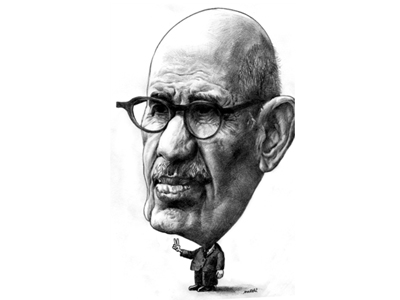
ElBaradei of Egypt is from the same material, mentality and personality of Chamberlain.
Mohamed Elbaradei, a former administrator of the International Atomic Energy Agency (IAEA) accepted the Egyptian ‘new deal’ earlier in July of this year and accepted the road map agreed upon among political and religious people after millions demanded the removal of the Muslim Brotherhood president of Egypt, Mohamed Morsi.
The Muslim Brotherhood rejected the deal and rejected the removal of their representative in the presidency and rejected the fact that the military acted upon the wishes of millions to remove the first civilian elected president of Egypt. Understandably so, the political organization that chose Islam as its slogan, waged demonstrations and protests. But the protests turned violent occasionally, and turned into more than demonstrations, but a state within a state. Tents were created in two main locations in Cairo, streets were closed, neighbourhoods were shut down, barracks from pulled up street and sidewalks stones were used to create fortified mini cities in the streets of Cairo.
The purpose was to create a mini society, a mini Muslim Brotherhood neighborhood with little schools and little hospitals and little restaurants and bathrooms. The purpose was to create a status quo that no Egyptian military would dare to touch. The Muslim Brotherhood had few options, either to say yes and move on, taking into account similar evolving democratic experiences mainly in Turkey and Pakistan, or to make one time deadly statement.
They chose the latter for one simple reason; the rejection the Muslim Brotherhood got from the Egyptian people was unprecedented in the Middle East. The Muslim Brotherhood built its reputation during its underground years when it was illegitimate up to the end of the rule of the former dictator Hosni Mubarak in 2011, as an alternative to modern Arabic political regimes that consisted of a combination of military generals and rich business class.
The Muslim Brotherhood had woven its chart among the Egyptian society using the magic word of Islam. They created charity organization, and created their own ‘virtual’ societies in Egypt and elsewhere. After the end of Mubarak, the Muslim Brotherhood won elections for one simple reason; the silent and lazy majority of Egypt that did not want to go and vote. The mini Chamberlains of Egypt and ElBaradei is among them.
The Egyptians woke up to strange people and stranger president.
On June 30, 2013 with support from the military and intelligence, the silent majority rose unchallenged and went to the streets and squares in a way that the military could not stop, it did not want to stop and Morsi did not want to accommodate. The generals acted and Morsi was gone forever; he will never come back. But with him, the Muslim Brotherhood also will not come back the way they are now.
The Muslim Brotherhood for over a month was not talking to Egypt, but it was talking to the outside world. The Muslim Brotherhood was not negotiating with Egypt but through invoices from this country or that. The Muslim Brotherhood waged a lost battle and war, because that war was against the people of Egypt and its military. ElBaradei, after accepting to be appointed an interim vice president back in July, resigned today as a protest to violence that Egypt did not choose and the generals could not avoid. Egypt will emerge stronger and more democratic but ElBaradei will not. ElBaradei chose to run away from responsibility and run away from a destiny that could have led him to the presidency. The world could not afford a Chamberlain in the first half of the 20th century and it cannot afford it now.
Photo Courtesy: electionsmeter.com