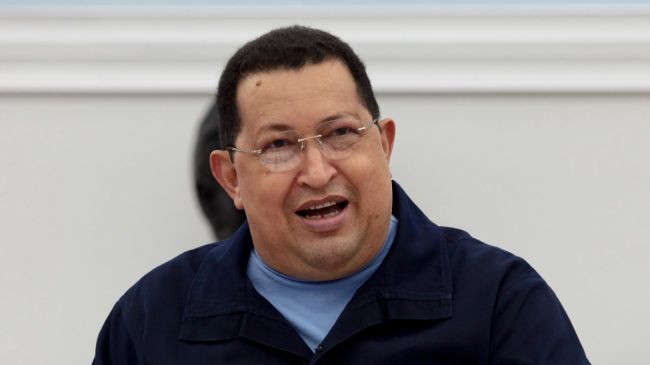
Events in Venezuela in recent weeks have been tumultuous to say the least. Questions like “Is he dead yet?” or “What happens to Venezuela if he dies?” have been propping up throughout the international community. All questions regarding the Hugo Chavez being elected as President. The condition of the president is not known exactly, we have seen the release of numerous government statements and speculations by those in the country are rampant. However, the president himself has not yet spoken.
 Chavez left Venezuela on 11 December to undergo his fourth cancer surgery in Havana, Cuba. Many have speculated on why he chose to be treated in Cuba instead of his own country; however his Ministers have stressed that this is to maintain a level of privacy surrounding his illness. This was over six weeks ago, and the president has not been seen since. This is particularly surprising for a man who is known for being in constant public eye, whether through his television series “Aló, Presidente” or his exciting and clamorous speeches.
Just recently we heard of the president’s condition escalating into dangerous territory, as he began to internally bleed and obtain a respiratory infection following his surgery. This was met with huge crowds gathering in churches across Venezuela, praying for the health of their Commandant. Concerts were cancelled and vigils have been held throughout the country. This was supplemented with official visits from presidents of Ecuador and Nicaragua, and more recently the presidents of Argentina and Peru. Signs of Chavez’s deteriorating health were evident when both Argentinian and Peruvian presidents were denied entry to see Chavez. Kirchner later commented on the need to respect the family’s right to privacy during a difficult time.
Constitutional debate was at the forefront in the weeks before 15 January when opposition members took to the media to voice their anger at the constitutional trespassing of the Chavez government. It was a time where people of all walks of life were arguing their interpretation of articles 231-4. This led to a series of debates surrounding the legitimacy of Chavez’s government, since Chavez missed his inauguration; he was accused of violating the rules of the constitution. The head of the National Assembly intervened, ruling that Chavez was not “permanently absent” as the opposition were claiming. Since he was only “temporarily” absent, he could return to take his oath as soon as he was better. This angered the opposition who accused the National Assembly of being ridden with “Chavistas”, a term which in itself is self-explainatory.
Signs of vitality came in the form of two government documents showing Chavez’s signature. The first document was one that appointed Elias Jaua as Foreign Minister and the second was a letter, written by Chavez, for the CELAC meeting in Chile. There have been accusations aimed at the government of forging these signatures and also arguments that if Chavez is able to write letters and sign papers, surely he can broadcast a message to his people showing them that he is well and alive. This does not seem to be much to ask, considering that it has been more than six weeks without a word from their President elect. More hopefully, Bolivia’s president, Evo Morales has told of his phone conversation with Chavez that confirms that the President is now in physical therapy and will soon return to his country.
The situation in Venezuela is tense; the vice-president has put forward claims that unidentified groups have entered the country with the aims of assassinating him and the head of the National Assembly. The extreme-right wing of Venezuela has also created a “coup petition” that aims to oust the current government under Nicolas Maduro. The petition calls on “the Venezuelan democratic society and their Armed Forces to restore the Constitution and to free themselves from Cuban tutelage.” Those who have signed include prominent figures such as Diego Arria, Oswaldo Alvarez Paz, Marcel Granier and MP Maria Corina Machado. Speculations about splits in the PSUV and opposition parties are also rampant.
No matter what happens in the coming weeks one thing is clear; whether Chavez recovers and returns or not, Venezuela remains fiercely and in some ways, incurably polarised.